Who is AdventureWorks? The story we've never properly told.
Greetings,
There's a ropes course in Henderson Valley, tucked into the bush, that belongs to a trust we helped create. There's a cohort of diploma students in West Auckland learning to lead in the outdoors. There are NZQA and NZOIA-qualified instructors working across the country, Youthworkers with a NZ Certificate, and thousands of school students on Outdoor Education experiences. None of that happened by accident.
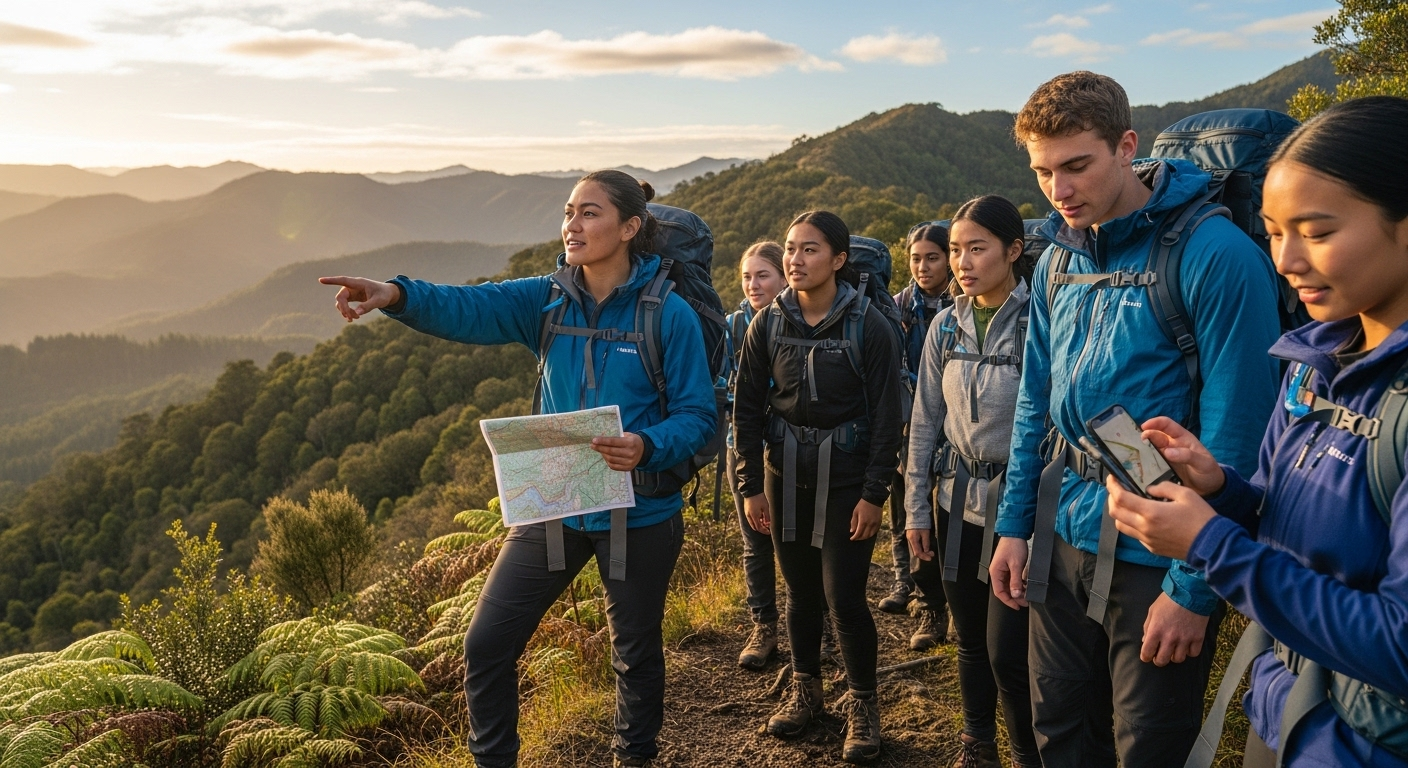
Growing people through leading and learning in the outdoors. Nine words. Fifteen years. Everything we've built has traced back to that idea — and we've never properly told the story of how.
Where we came from
AdventureWorks didn't begin with me. It was originated by Liz Penman — a practitioner of rare consistency and diligence, now operating Project Adventure New Zealand — who built a reputation the sector genuinely respected. High ropes training, experiential learning, and quality facilitation. The kind of reputation that takes years to earn and is felt, not just reported.
I bought the business in 2011, coming from a teaching background — most recently running an outdoor education programme at a secondary school in the South Island. On paper, a reasonable transition. In practice, the feeling was something closer to overwhelming. How do you take on something built to that standard and not diminish it?
The honest answer is: you dive in and learn to swim.
The teaching background turned out to be a genuine strength — the instinct for relationships, for programme design, for meeting people where they are. But running a business was a completely different dialect. Cashflow, compliance, conflicting stakeholder needs, the particular kind of acumen required to keep an organisation financially viable while staying true to its purpose — that was learned from the beginning, with a few mistakes along the way.
What kept it grounded was a clear sense of what AdventureWorks was actually for. Not a business to be managed, but a platform — for meaningful, intentional programming that resulted in powerful experiences for participants, and for deepening an awareness of the real value of our natural environment. That purpose was the compass when everything else felt uncertain.
Liz never left. Fifteen years on, she is still alongside us — still the benchmark, holding us to account — and currently working closely with us on the development of our leadership qualifications and new micro-credentials. What started as a handover became something more like a long collaboration. We're grateful for that every time the standard she set quietly reminds us what we're aiming for.
What the early years taught us
When I took over, AdventureWorks was one thing: a ropes course at UNITEC. That was it. One service, one site, one inherited client base. Duke of Edinburgh came early in the second year — not a grand strategic pivot, just the next right thing that fitted what we were building.
What followed was a decade of learning by doing. The Graham Dingle Foundation's Project K programme became a significant part of our work for nearly ten years — we cut our teeth on sixty of those programmes — working alongside young people for whom the outdoors wasn't recreation, it was revelation. Challenge, consequence, belonging, belief. The kind of outcomes that are hard to manufacture and impossible to fake.
Purpose, it turned out, wasn't something we declared. It was something we discovered. In the early years it took time to work out exactly what we were for, and how to align what we did well with the opportunities in front of us. But across the ropes course sessions, the Duke of Ed expeditions, the Project K journeys — the same thing kept being true. People grew. The outdoors did something to them that other environments couldn't replicate.
By the time we put it into words, it wasn't invention. It was recognition. Growing People Through Leading and Learning in the Outdoors. Named, finally, what had been true all along.
Underneath all of it sits something that doesn't always make it onto a website or a course outline: my background in counselling. A human-centred lens on the world — the belief that people can become who they want to be, and overcome who they don't want to be — has quietly shaped everything about how AdventureWorks operates. With participants. With students. And just as importantly, with staff.
Because none of this happens alone. We have been — and continue to be — genuinely fortunate in the people who have chosen to commit their time, effort, and passion to this work alongside us. That's not a throwaway line. The quality, the continuity, and the character of AdventureWorks is inseparable from the people who have built it with us. I am deeply grateful for each of them.
That foundation — the early years of genuine youth development work, of following purpose before strategy, shaped by people who believed in what we were doing — runs underneath everything that came next. The diploma. The qualification pathway. The assessment centre. None of it would look the way it does without the decade that preceded it.
The pipeline dries up
For years, the Auckland outdoor sector had been quietly sustained by a steady stream of graduates from the Diploma of Outdoor Recreation Leadership — the DORL. A benchmark programme, forged over years by outdoor legends, that produced work-ready practitioners who could walk into an organisation like ours and contribute meaningfully from the start.
When it finished its final intake in 2014, the pipeline didn't stop overnight. But it changed. Gradually, and then noticeably.
Which brings us to something that has become an AdventureWorks operating principle — one you'll probably recognise across everything we've done. Where's the need? Does it align with our purpose? Let's give it a go.
We registered as a Private Training Establishment in 2015. What that actually meant in practice — the governance, the compliance, the NZQA regulatory requirements, the programme endorsement and moderation processes — was another entirely new dialect to learn from scratch. The teaching background helped with the pedagogy. It did nothing to prepare me for the labyrinth of tertiary education administration. That was steep in ways I hadn't anticipated.
And beyond the compliance, there was the deeper challenge: we were a new provider with no reputation in the tertiary space. No track record. No credibility. Putting a programme into the market and asking people to trust it — to invest their time, their fees, their career trajectory in it — felt enormous. But we believed in ourselves. We knew we could do it.
2015 was also a year that changed everything in a more personal sense. In January, I sustained a spinal cord injury that left me quadriplegic — and what followed was a reckoning, not with what had been lost, but with what was possible. There was every chance the business wouldn't survive. That it did owes everything to three people: Rachel and Robin, who stepped up with a commitment and capability I simply cannot overstate, and Liz, whose steady presence never wavered. I am profoundly grateful to them. The purpose was still there, the work was still there, and the people who chose to be part of it made sure we kept going.
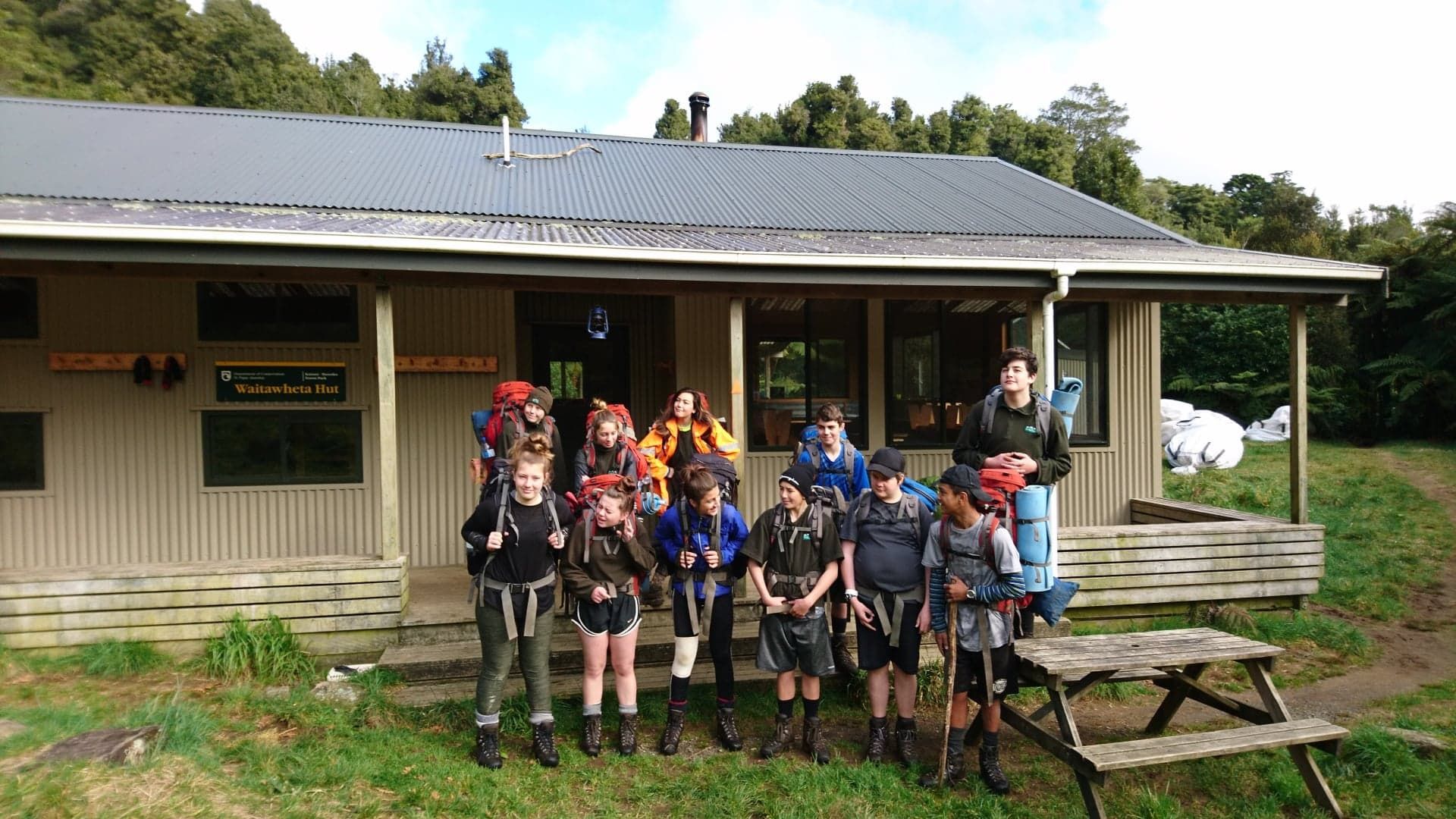
Before the diploma cohorts arrived, another door opened that we hadn't anticipated. In 2019, we began delivering programmes to Year 12 and 13 students under the Trades Academy funding model. One day a week, students from across West Auckland came to our campus to complete either an Outdoor Education and Recreation programme or a Uniformed Services programme — earning credits toward NCEA while getting a genuine taste of what a career beyond the classroom might look like.
It was a meaningful addition to what we were building. The students who come through aren't necessarily heading into outdoor education — some were, but many were simply young people exploring what was possible for them. That suited us fine. Giving people a wider sense of what they might become has always been part of our work.
Our first intake for the NZ Certificate in Outdoor and Adventure Education Level 4 was 2020. Our first diploma graduates completed at the end of 2021. It's worth being clear about what that diploma is: the same qualification offered by polytechnics and Hillary Outdoors across New Zealand. We're not a niche alternative — we're operating alongside them, delivering to the same national standard. It has taken five years since then to build the trust and credibility the programme now carries. Reputation in the tertiary space isn't granted. It's earned through delivery, consistency, and outcomes. We have that now. We're proud of it.
One other qualification quietly came online in 2022. The New Zealand Certificate in Youth Work (Adventure and Nature Based) sits at the intersection of everything AdventureWorks has always stood for — bringing together the outdoor environment, youth development practice, and the strengths-based, human-centred approach that has shaped everything we do. For people working in youth-facing roles who want to ground their practice in the outdoors, it filled a gap that no other provider was addressing.
The next problem to solve
By the time we had a functioning Diploma programme, we were already looking at the next problem.
For years, AdventureWorks had worked within the industry training organisation system — supporting our own staff through work-based learning to gain NZQA qualifications through Skills Active. We understood what the ITO model was trying to do, and we respected the intent behind it. But we were also close enough to the reality to see its structural limitations clearly.
The work-based mode placed the primary responsibility for training on the workplace. For large organisations with dedicated training staff and operational capacity, that's manageable. For the outdoor recreation and tourism sector — dominated by small businesses running on lean capital, seasonal staffing, and stretched resources — it was genuinely difficult. The qualification existed on paper. In practice, accessing it meaningfully without it becoming a burden on the workplace was another matter.
And we knew this not just as observers. We were part of the problem ourselves. As a small workplace trying to run a business on low capital, we had struggled with exactly the same constraints we were trying to solve. That gave us a particular kind of clarity about what a better system needed to look like.
The answer, we believed, was the provider-based mode of delivery. Shift the full responsibility for training and assessment to the provider. Reduce the burden on the workplace to near zero. Fund it at a level that made genuine delivery possible. It was massively more demanding for us — but it was the only model we believed could work meaningfully for our industry.
Where's the need? Does the solution align with our purpose and values? Let's give it a go.
There was another dimension to this that mattered enormously. The outdoor sector had long recognised a gap between NZQA qualifications and NZOIA membership — the professional recognition that gives credibility in this industry. The two pathways had always run in parallel, never quite connecting. The structural constraints of the work-based model had made bridging them almost impossible.
The provider-based model changed that. It gave us the ability to go to NZOIA with a genuine proposition: embed their rigorous assessment standards directly into our programmes, so that graduates complete an NZOIA qualification concurrently with their NZQA qualification, gain their first year of NZOIA membership on graduation.
We signed an accreditation agreement with NZOIA to become an accredited Assessment Centre covering both our diploma and strand qualification graduates. For the first time, the bridge existed. Learners didn't have to choose between a national qualification and professional recognition — they could earn both through a single, coherent programme. That was a genuine milestone for the sector, not just for us.
The wider landscape kept shifting. The Reform of Vocational Education forced significant structural change across the tertiary system. Skills Active's transition to Te Mahi Ako as a private training establishment was, in our view, actually the better outcome — it preserved meaningful autonomy for outdoor recreation qualifications within a system that could easily have absorbed them into something much larger, with much bigger priorities than ours.
But in October 2025, Te Mahi Ako announced they would not be continuing with outdoor recreation qualifications.
Another gap. Another problem to solve. The difference this time is that we are not starting from scratch. We have the programmes, the relationships, the NZOIA accreditation, the assessment infrastructure, and a track record of delivery. We are motivated, prepared, and ready to step in — not because the opportunity suits us, but because the industry needs it.
None of that came without its own steep learning curve. Developing a Diploma with students in your building every day is one thing. Developing an engaging blended learning programme — online learning, tutor support, engaging content — for outdoor instructors is quite another. Asking outdoor instructors to sit still in front of a screen is, it turns out, a particular kind of challenge. I say that with complete self-awareness, because I am exactly the same.
Building systems that supported learning without getting in the way of learning sounds straightforward. It was not. Add the logistics of running training and assessment events across the country, coordinating a small group of expert trainers and assessors who have been absolutely instrumental to what we've built, and maintaining the student-centred values that sit at the core of everything we do — and the growing pains were real.
The rest of what we do — and where we're headed
Qualifications are only part of the picture. AdventureWorks continues to deliver EOTC programmes and unit standards for schools, Duke of Edinburgh, an Adventure Development programme focused on therapeutic outcomes for youth, and our Adventure Essentials adult course range. We also share a high-ropes facility in Henderson Valley — the one mentioned at the start — through a trust we helped establish, now operating in partnership with Adventure Specialties Trust and Project Adventure New Zealand. Three organisations, one outstanding facility, built on a creative solution rather than competition. That's how we prefer to operate.
2026 is a significant year for us. We are stepping into the gap left by Te Mahi Ako's withdrawal from outdoor recreation qualifications — and we are doing it with a fuller suite of offerings than we have ever had.
This year we will be delivering new EOTC micro-credentials at Levels 6 and 7 in partnership with Education Outdoors New Zealand, who will be delivering the new qualifications that emerged from last year's qualifications review. This includes a Level 7 Professional Practices qualification specifically designed for people in operations and management roles responsible for their organisation's Safety Management System — and for meeting the requirements of the Adventure Activity Regulations. That is a qualification this industry has genuinely needed.
Later in the year, we will transition to the updated version of the NZQA outdoor instructor qualifications, which all move up one level— a move that better reflects the skills, knowledge, and experience genuinely required of people leading in the outdoors. The level shift is appropriate, and long overdue.
We are also introducing two short online courses developed in partnership with Education Outdoors New Zealand and supported by Sport New Zealand: an introductory risk management course for outdoor educators taking their first steps in understanding safety and running outdoor activities for groups, and an online video-based course in inclusive practices for outdoor leaders. Accessible, practical, and designed for the people who need them most.
All of it — every qualification, every programme, every course — traces back to the same nine words it always has.
Growing people through leading and learning in the outdoors.
We have more to say. About the sector, about what we're seeing, about the questions we think are worth asking out loud. This is where that conversation starts. I'd genuinely love to hear from you.
Mark Mandeno
Director, AdventureWorks mark@adventureworks.co.nz | 09 846 2644 | adventureworks.co.nz